

With the NSW Office of Energy and Climate Change (OECC) I helped design a tool to help revegetation projects adapt to climate change, letting project managers compare future climate modelling for their chosen species types.
This work won an Australian Good Design Award.
Context
The Office of Energy & Climate Change leads NSW in responding to the challenges of a rapidly changing climate.
Co-designing with citizens, policymakers and businesses, we prototyped a tool that empowers anyone to confidently plant climate-adjusted seeds. Enabling today’s actions to preserve tomorrow’s environment, and ensure survival of our diverse ecosystems.
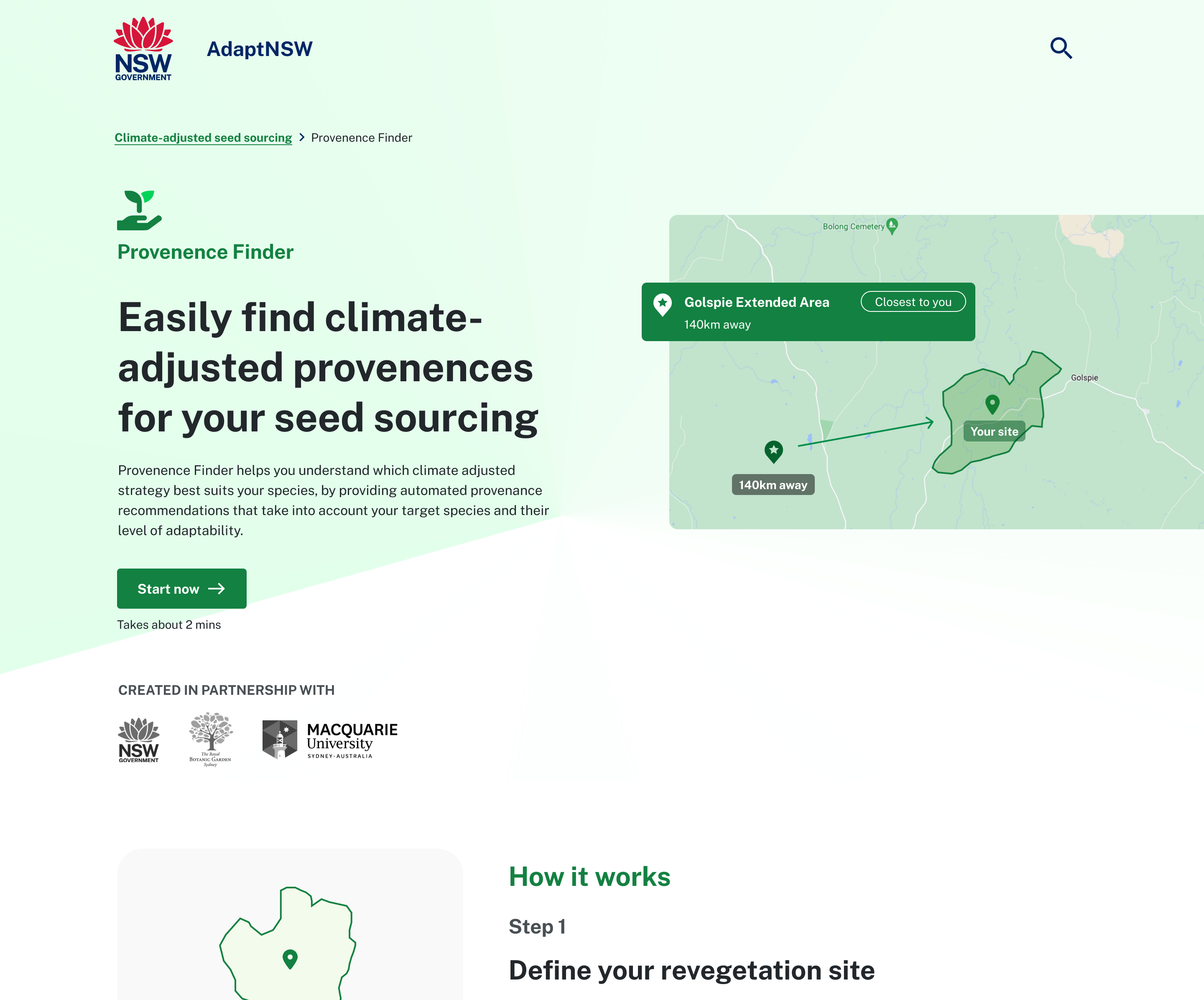
Real-world seed sourcing
The revegetation industry is complicated and project managers work in many contexts. Some are small communities protecting habitat, and others are large mining companies fulfilling their legal obligations to rehabilitate mining sites after their closure.
Many of these project requirements meant that specific species and flora varieties were mandatory. You can't tell someone revegetating land to pick an entirely different plant that deals with heat better.
You can, however, give that person tools to figure out if that same species is known to adapt to hotter versions of their project sites microclimate — and make it easy for them to source some of their seeds or tube stock from that location instead of locally.
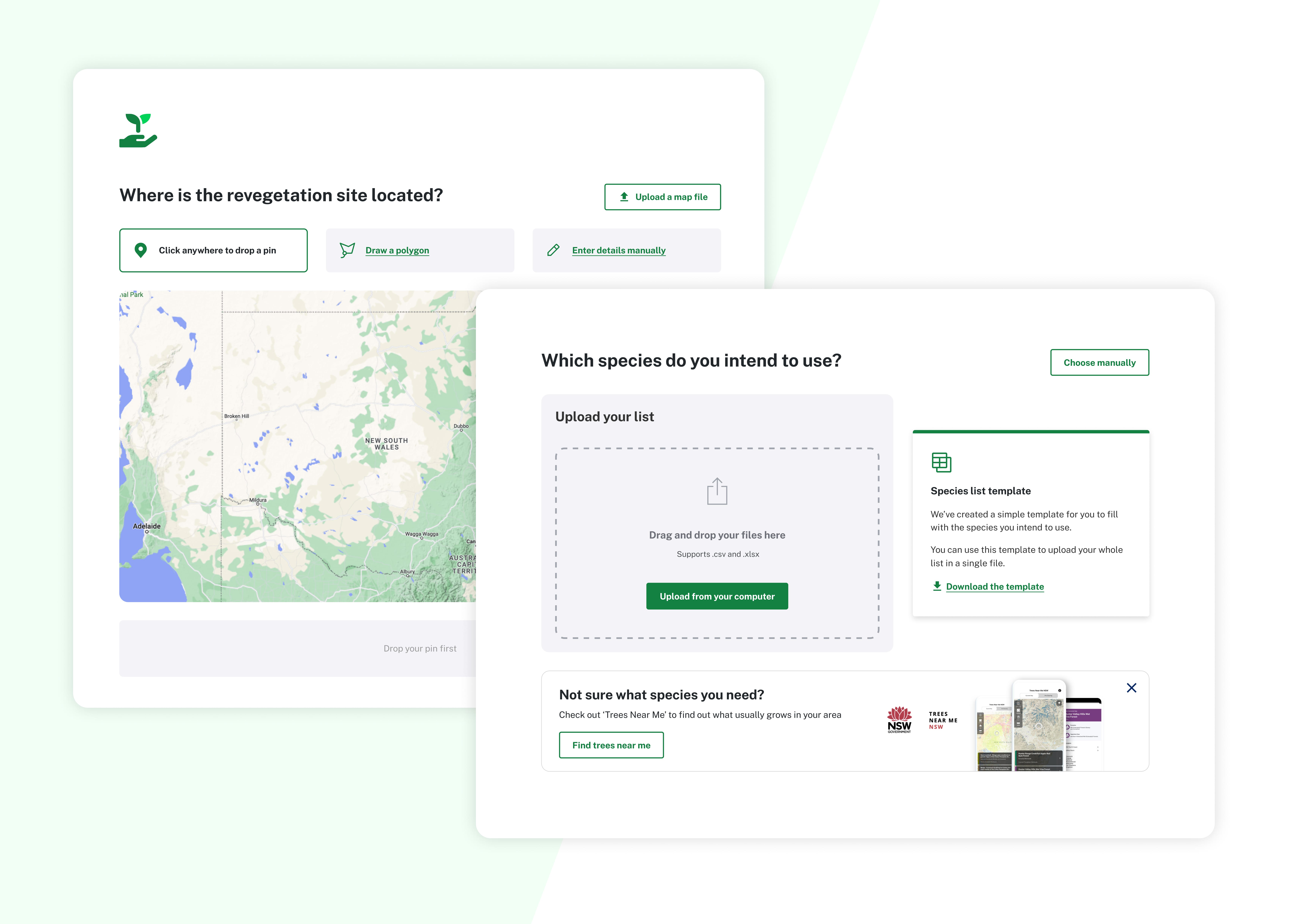
Our tool let people navigate this data for their revegetation site and determine where to source seeds for climate-adapted genetic diversity and whether a species is even viable long-term.
The core of the tool
At the core of the prototype was a combination dataset that could predict the suitability of seeds being planted at a revegetation site.
By combining complex climate modelling with an easy-to-use tool, we enabled anybody to explore their species and project site climate predictions and species viability.
Of course, when you revegetate, you want to ensure you have a genetic diversity in your seed and sapling choices to maximise chances of success. These seeds were not to be the only source, but a supplemental source to that of locally sourced stock for climate-adapted genetic diversity.
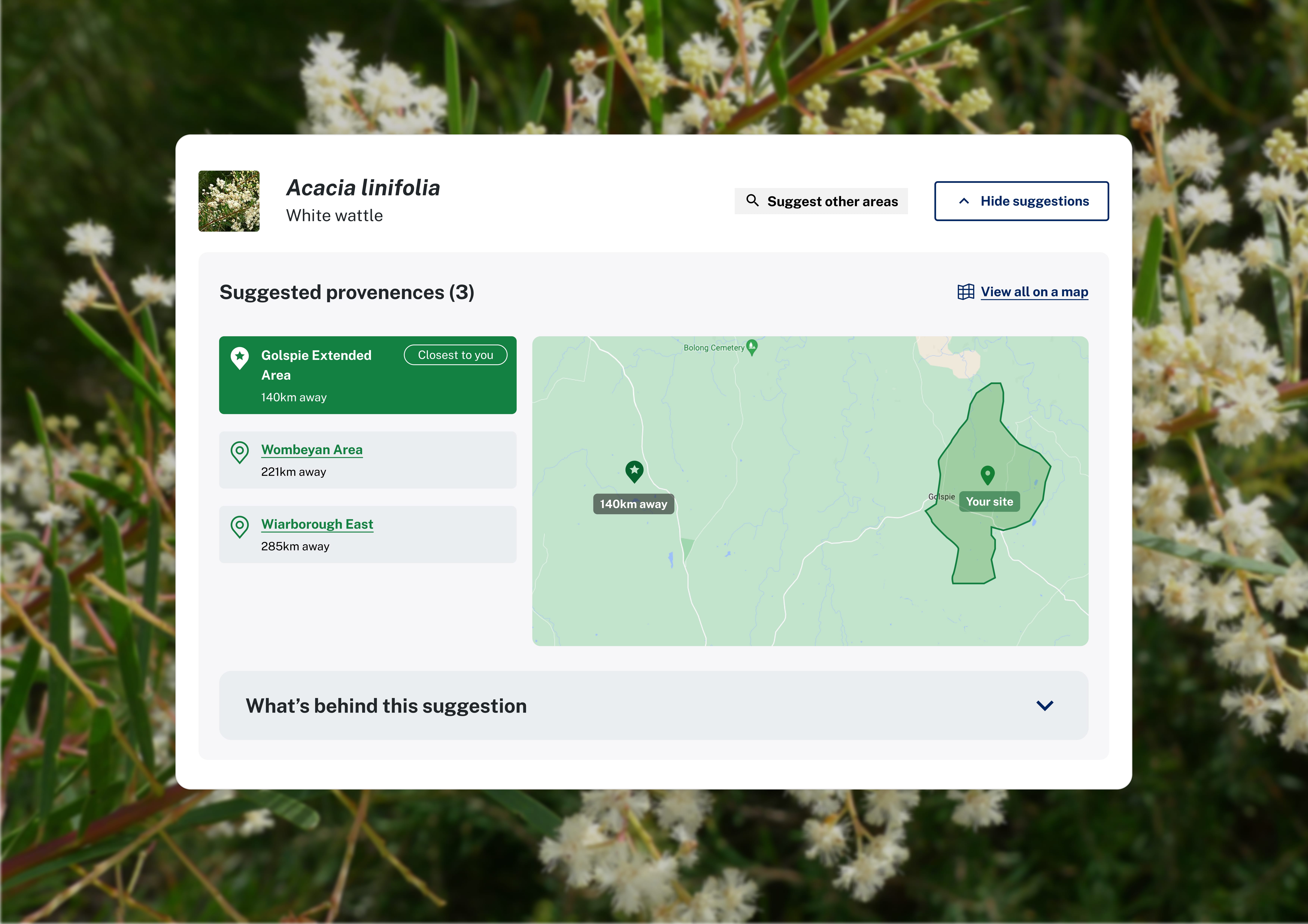
In reaction to our prototype making it easy to understand and navigate this data in relation to their site, one project manager said
“The challenge is crunching the numbers and working out what we can do. I’m just excited to see that this is being developed!"
Learning
Revegetation is difficult enough, and no government website telling you how to change your genetic seed diversity will help. Nurseries and tree planting organisations are more concerned about a basic survival rate and propagation.
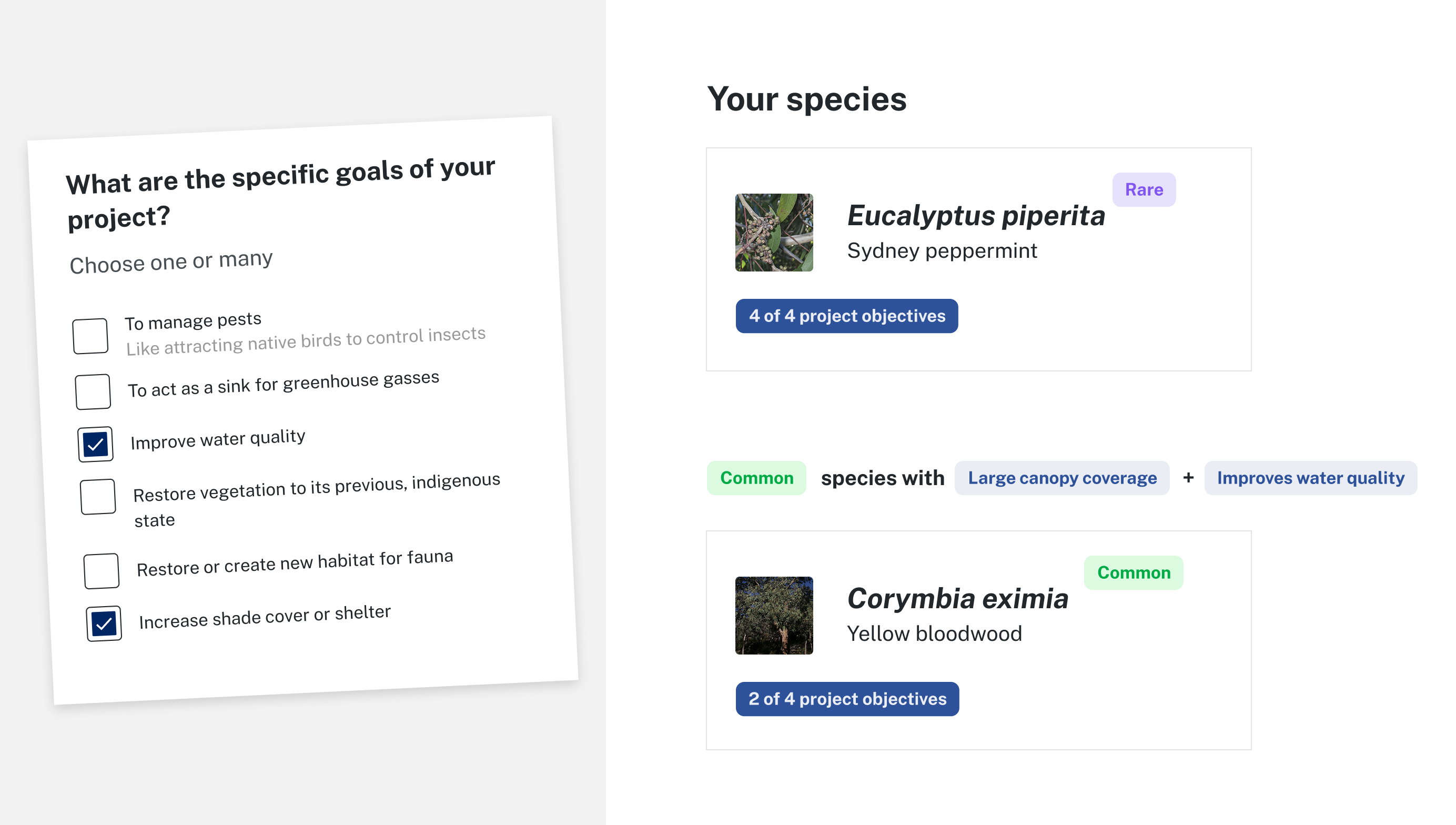
Environmental data services in government should be available to help without dictation, and focus their efforts on customisation to make the outputs as believable and approachable as possible. We need to avoid "You must" because priorities are complex. We should instead say "You could try" and enable climate-friendly project decisions without shame or pressure.
In collaboration with
- Claudette Yazbek, Product Manager
- Simon Hopkins, Research
- Isobel Cummings, SME